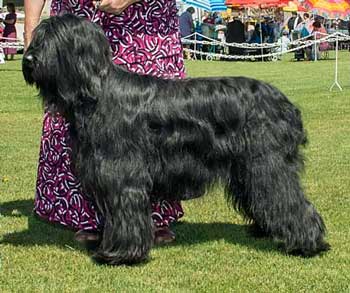
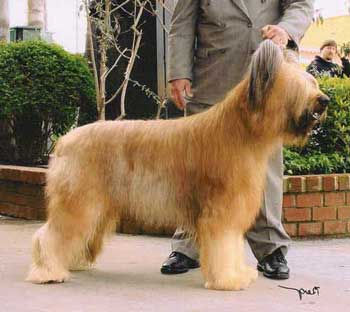
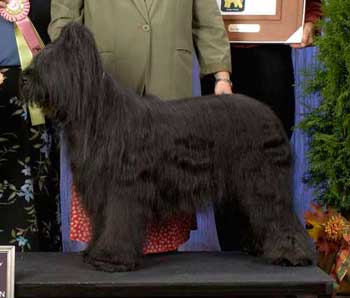
Grooming sounds easy - just brush! OTOH, it looks very intimidating - all that coat on the Briards you've seen pictures of. The reality is in the middle - more than just brushing, less than what the Westminster Kennel Club winner goes through.
Grooming starts with training as a puppy. Long before they NEED grooming, they have to be used to grooming. It starts with a gentle use of a brush, with lots of rewards. Gradually increase the time spent brushing, and be sure you decide when to stop, not the puppy. Most will eventually lay down and relax. If necessary, get the puppy used to being picked up and placed on it's side.
Grooming is much easier and more effective if the dog is laying down. Once the dog is comfortable laying down and being brushed, add the comb. And play with the toes! Someone is going to have to trim those nails, and handling the feet from day one makes that much easier.
You can groom on the floor, the bed, the couch... but a table is so much easier. A 42" length works well for most Briards. Shop online, or attend a dog show and buy from a vendor. Tables can range from $100 to $250 for a basic table.
Now your briard has some coat
The best way to groom a Briard is to "line brush". To start, take all the coat on the leg and quickly brush it upwards. Then, starting at the foot, begin brushing it back down. There will be a line to the skin between the hair going up, and what you have brushed down. Gradually, move this line up the leg, by brushing more hair down, a little at a time. With each brush stroke, you are picking up a little more hair. You can proceed over the whole dog by moving that line, gradually taking more and more hair with each brush stroke.
Many groomers use a spray bottle to lightly mist the coat as they go, helping to prevent breakage. This may be water, or a detangling / anti-static spray, or a light conditioner.
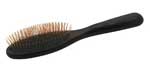 I use brushes from Chris Christensen. My favorite is the 20mm Fusion, which is costly at around $50.
If you are just grooming one Briard, a lesser quality brush will do. Pin length of 20 - 27 mm is best.
Many owners use a slicker brush / comb. Take care - used improperly, this can pull out the good outer coat, and leave the soft coat looking groomed, but actually matted. It can be helpful around the elbows and behind the ears.
Combing
Once an area is brushed out, I use the poodle comb to go through the coat. This makes sure you have gotten all the way to the skin, and finds any missed matts. Always brush first, or the comb will pull out hair, or break it. The greyhound comb can be used to remove any tiny tangles, especially in areas such as around the dewclaws.
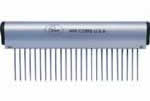 I wouldn't be without my Resco #80 Coarse comb. Essential!
I can't count the number of these combs I've given away. I buy off the internet, whoever is cheapest.
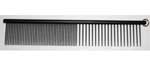 A Greyhound comb is very handy. I'm not picky about the brand, just a medium / coarse combo. Teflon coated is nice.
Mats? Of course my Briards never get mats!
Right. Mats sneak up on you. No one plans to let a Briard get matted, but it happens. NEVER WASH A MATTED BRIARD. It will make it almost impossible to get the mats out. Begin by brushing. When you hit a mat, use your fingers to pull it apart from the base. Using fingers and the brush, most mats can be worked through, but it takes time and patience. You can also use the end of the poodle comb, pulling a few strands of hair from the mat at a time, always working from the base of the mat. In very bad mats, use scissors to cut along the lengthwise direction of the hair, and then back to fingers or comb.
Worst case scenario, cut out mats. And in some cases, the kindest thing you can do is have your Briard shaved down, and take care of the coat as it grows back. Yanking and pulling on the coat to rip out mats is no fun for a dog.
If a Briard coat is truly neglected, a felt-like mat can cover the entire body. This has to be shaved off, usually by a professional. I have seen felted coats where the owners genuinely thought they were grooming, but they never got to the skin. That's why the use of a poodle comb is so invaluable. It reaches the skin, or tells you more work is needed.
Some owners use a mat cutter, or a furminator on their Briards. I don't use either.
Raking
Raking removes a lot of coat! Done right, it removes the old, dead coat and excess undercoat. It can be used at the right time to prevent a lot of matting right before a coat change, such as losing the puppy coat at 10 to 12 months of age. The whole appearance of a dog can change when all the dull old coat is gone, and the new shiny harsher coat is visible. Raking several months before a big show gives new coat a chance to really grow. And raking regularly can make a pet dog easier to groom by removing undercoat, while still allowing the length of a show coat.
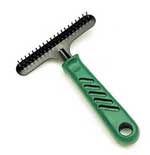 Undercoat Rake, for removing old, dead coat.
Bathing
How often should a Briard be bathed? That depends on the coat quality, and the owner. A good, harsh coat can be cleaned by brushing, and will need bathing less often. A soft coat will collect dirt and oils, and need bathing more often. And more bathing makes the coat still softer. Some owners want weekly baths for the fresh smell and feel. My dogs get several baths a year, if they are not being shown.
Look for a shampoo that does not say "soft" or "silky". I use a crisp coat or harsh coat shampoo, to maintain texture. Rinse out any shampoo very well. If you desire, use a very light conditioner (I don't, many do). For show, we blow the coat dry while brushing, but air drying certainly works for home.
What to cut?
Briards are a natural breed, but some scissoring is normal. Trimming the hair on the feet to be a nice circular shape, instead of "snowshoes", makes them easier to groom, and movement looks prettier. And trimming the hair between the eyes can help them see, and their eyes be seen. Some Briards, especially puppies, get hair growing from between the eyes straight over the eyes, blocking vision even more than normal.
Many pet owners keep Briards in a short cut, or shaved down. From my experience, senior citizen Briards prefer to be shaved, and skip the hassle of grooming. If you are going to shave, do it a few weeks before cold weather arrives.
You can spend $10 or $200+. Useful for trimming feet, cutting out matts, etc.
Thinning shears are great for between the eyes, and thinning the hair over the eyes.
Nails - Be sure to regularly trim or file nails. If you can hear your Briard click when it walks on a hard floor, the nails are too long! For comfort, please don't let that happen. Dewclaws will grow in a circle. If these are not kept trimmed, they will catch on a branch or vine, and can be ripped right out. Don't forget the dewclaws!
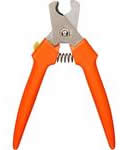 I prefer this style of nail trimmer, much easier to see what you are doing.
Ears - Ears can get dirty. There are a number of products you can use for routine cleaning. Don't get too much moisture in the ear, and don't stick a q-tip down the ear.
Anus - Keeping the hair trimmed around the anus will minimoze those times you have to wash a dirty butt.